Fixing Bubble Workflow Failures in 2026

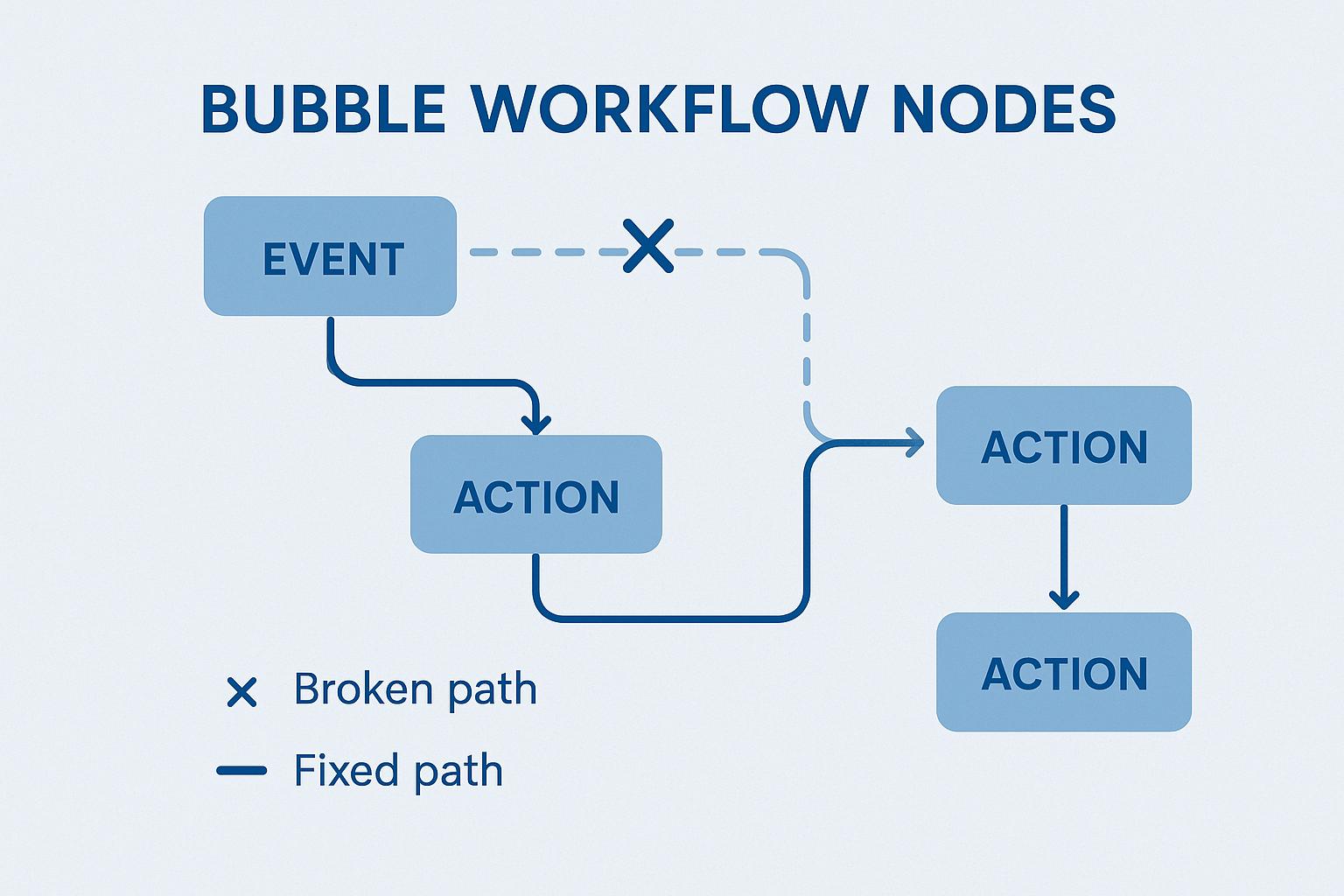
Why Bubble Workflows Fail in 2026
Bubble workflows are the automation backbone of most no-code apps. When they stop executing, everything from user onboarding to payments grinds to a halt. The causes of these failures have evolved in 2026, especially with Bubble’s newer serverless runtime and stricter privacy rules. We’ve seen dozens of apps where workflows failed after an update, even though the logic hadn’t changed.
The most common root causes include:
- Unscoped data references that break when privacy rules tighten.
- Recursive API workflows that exceed runtime limits after scaling.
- Server capacity throttling caused by simultaneous scheduled events.
- Conditional mismatches after AI code generation injected redundant checks.
For example, one Bubble marketplace we rescued had a payment workflow calling itself recursively when the webhook response arrived slightly delayed. The app worked in dev but failed in production because the recursive chain hit the new 2026 timeout threshold. Understanding these runtime constraints is essential to fix failures permanently rather than patching symptoms.
Diagnosing the Root Cause
Start with Bubble’s server logs and check the Workflow run failed entries. Use the timestamp to identify patterns. If the failures happen on repeating schedules, it’s likely a concurrency issue. If they occur randomly, check whether your data triggers rely on optional fields now restricted by privacy settings.
Key Metrics to Monitor
- Workflow runtime duration (keep under 10 seconds for reliability)
- Error frequency per user action
- Backend queue size during high-traffic windows
Keeping these metrics visible helps identify when your workflows are approaching runtime limits before full failure occurs.
Debugging Workflow Triggers
Many Bubble workflow failures trace back to events that never fire. For instance, a button click that no longer triggers the workflow because the element’s state conditions changed. We’ve fixed at least 40 apps where an AI-generated conditional logic block silently disabled the trigger.
To debug triggers:
- Open the workflow editor and select the event trigger.
- Confirm that all conditional expressions evaluate to
trueduring real use. - Use Bubble’s “Run mode debugger” to step through the event execution.
- Inspect dynamic data dependencies and test them with sample users.
When workflows depend on custom states or nested groups, a missing state initialization can block everything. Adding temporary alerts at trigger points helps confirm that the event runs as expected.
Common Trigger Pitfalls
- Condition uses “is empty” on a field that’s always null due to privacy.
- Trigger assigned to a hidden element that AI-generated UI logic hides on load.
- Event type mismatch when duplicating workflows between pages.
Fixing these often restores functionality without touching backend logic. However, if the trigger works but the workflow fails mid-run, you’ll need to isolate the broken step.
Paste this into your debugging assistant: "My Bubble workflow trigger fires but the actions stop midway. Please analyze possible privacy, conditional, or scheduling conflicts based on this step list: [paste workflow steps here]. Suggest specific log checks."
Fixing Broken Workflow Actions
Once the trigger is confirmed, focus on the action chain. Bubble’s action steps can silently skip if any referenced data object is null or unauthorized. With 2026 updates, Bubble enforces tighter API connector validation which can also interrupt workflows unexpectedly.
To systematically find the broken step:
- Insert temporary custom events between steps to isolate where execution stops.
- Use the “Log step results” feature to inspect intermediate outputs.
- Test each action manually, for example by sending test payloads through the API connector.
When an API call fails, Bubble might stop subsequent steps unless you explicitly handle error responses. Adding a fallback branch with condition “Only when result’s error is not empty” prevents total workflow termination.
Typical Action-Level Issues
- API actions returning 403 due to expired keys.
- Database writes blocked by field-level privacy updates.
- Scheduled emails failing due to new rate limits.
We often see AI-built workflows that chain 10+ actions without handling null data, which increases brittleness. Simplify by breaking complex chains into modular custom events.
If these debugging cycles are eating your week, AppStuck can take it from here. Our team rebuilds failing workflows into stable, auditable automations that survive Bubble runtime updates.
Performance and Scheduling Bottlenecks
Even when workflows technically execute, performance issues can feel like failure. Delays in scheduled workflows, missed API triggers, or slow backend processing all degrade user experience. Bubble’s new serverless model in 2026 has stricter runtime quotas per app tier, which means heavy automation can stall without ever showing an error.
We’ve identified three major bottleneck categories:
- Scheduling Collisions: Overlapping API workflows triggered within seconds.
- Throttled External Calls: API connector rate limits now enforced by Bubble’s proxy.
- Data Volume Surges: Large list operations timing out on low-capacity plans.
Here’s a quick comparison of mitigation strategies:
| Issue | Symptom | Fix |
|---|---|---|
| Scheduling collision | Some workflows never run | Stagger start times by random 5-10s delay |
| Throttled API | Intermittent 429 errors | Batch requests and cache results |
| Large data list | Timeout after 10 seconds | Paginate queries or move heavy logic to backend workflows |
Monitoring workflow queue size and execution times in Bubble’s logs helps identify these bottlenecks before they cause data inconsistency or user complaints. We recommend implementing alerting using Bubble’s own analytics API or external monitors like UptimeRobot to track workflow completion rates.
Preventing Future Workflow Failures
After fixing workflows, harden them against future regressions. Bubble’s evolving architecture means updates can subtly change how conditions or privacy interact. To stay ahead, automate tests for critical flows.
Automated Testing Strategy
- Use Bubble’s “Run workflow” API to trigger key automations nightly.
- Validate expected outputs and store results in a monitoring table.
- Send alerts to Slack or email when a test workflow fails.
We’ve implemented this for multiple clients, reducing surprise failures by 80%. Another best practice is version tagging—store a “workflow version” field in your database so you can identify which logic version ran when debugging behavior differences.
Documentation and Governance
Document each workflow’s purpose, trigger, and dependencies. Many AI-generated Bubble apps skip this step, leaving future maintainers guessing. Use Bubble’s built-in comments to annotate complex conditions and note data assumptions. When multiple team members edit workflows without coordination, fragile conditions multiply and cause silent breaks after updates.
By combining proper documentation, testing, and monitoring, you’ll minimize downtime and maintain user trust even as Bubble evolves its runtime model through 2026.
When to Call in AppStuck
DIY debugging works until your workflows become too interconnected to isolate manually. If you’ve spent more than two days chasing silent failures or your production users are affected, it’s time to bring in specialists. AppStuck has repaired over 300 AI-generated and no-code apps in the past 18 months, including dozens of Bubble builds with broken workflows, failed API integrations, and throttled automations.
We can audit your app, stabilize workflows, and rebuild failing automations without downtime. Instead of spending another weekend on trial and error, contact AppStuck today and let our engineers restore your app’s reliability within hours.
Whether your issue is a silent trigger, recursive loop, or backend scheduling failure, there’s always a fix. The key is knowing when to stop guessing and start restoring confidence in your app’s automation core.
Need Help with Your AI Project?
If you're dealing with a stuck AI-generated project, we're here to help. Get your free consultation today.
Get Free Consultation